Requirements - Deals and Listings

Requirements - Deals and Listings

Loft offers a Requirements checklist, a place where you can add any document or action (workflow) requirements to the Deals or Listings for ease of tracking compliance. Please note,  Loft has not yet released our compliance automation solution, so if agents are missing documents, manually message them through the deal comments. 
Changes introduced September 2025 include; 

1. Changes to menu navigation
2. Updates to States (and colour options)

Create a Requirement - we have moved the Requirements / Listing Requirements to one central place, called Requirement Templates

Menu changes:

When you are in the new Requirements Template menu, you'll see new options, to add our default / suggested templates.

Document Deal Task Fields now offer tags & also the option to apply a requirement to deals, listings or both.

Name - Name the Requirement
Target Type - Set if the requirement related to listings, deals or both
Deal Side - All, list, sell, Agent double end
Deal Type - Set the deal type for the requirement
Deal Sub Type - Set deal sub types, if you use the sub types in Deal>Details
Property Type - Set the Property type for the requirement
Provinces/States - Set the province
Requirement Type - Document or Action
Required - Yes / No
Due Date - Set the requirement date
Expire At - Set an expiration date for the requirements


Deal Requirements that are set to required, need to be marked as Accepted.
Prior to a deal being closed, these required requirements must be Accepted, or moved to a Not Applicable status.

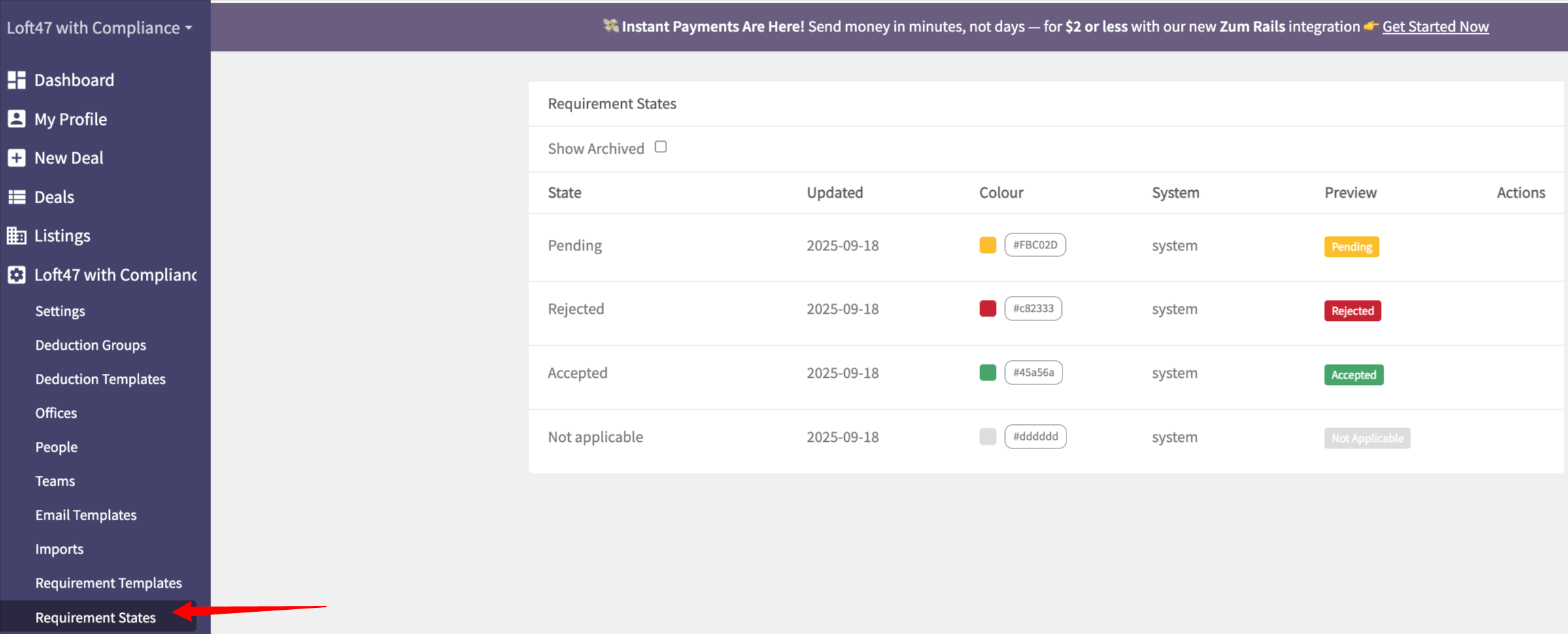
Requirement States have also been added:

Utilize Requirements with a Deal 

Loft offers two ways to manage deal-related files and compliance items:

  1. Documents - available in all versions (Your Requirements will display on each Deal and/or Listing Summary Page)
  2. Requirements - available in the Enterprise version only

1. The Standard Documents management feature allows users to:
  1. Upload, review, delete, re-name and manage deal-related files,  review, 
  2. Organize transaction paperwork 
  3. Track standard document submissions 
In Documents, As shown below: 


On the Deal Summary page > click the Requirement Name (blue link) to access or edit the requirement.

Here, you can set a deal-specific due date and attach uploaded deal documents to the requirement.

Use the Actions dropdown to change the status of that document or task.


2. The Requirements Section is part of the Enterprise Version and provides advanced compliance tracking.
  1. Create structured requirement templates
  2. Track mandatory compliance items
  3. Automate requirement assignments
  4. Monitor completion status directly within the Deal Summary

To set up Paid Requirements > go to Brokerage Settings > turn on the Paid Requirements option > save changes.
Once your administrator has set up the deal requirements:
  1. you can upload your documents by clicking upload files as below window
  2. you can also assign your documents to each requirement by clicking Selecting Requirement


  1. Once assigned your documents, you can select the requirement link (all links in Loft are blue) to review each required document as below
  1. You can add comments, upload File, and move on to the next requirement or back to requirement by clicking "<" or ">" and "Back to Requirements"  show as below 

Listing Requirements

Requirement templates set to apply to Listings will populate similarly on the Listing summary page.


What Happens When a Requirement Template is Archived?
1. Archiving does not delete the template or affect historical data.
2. Once a requirement template is archived, it will no longer appear when adding requirements to New Deals or existing pending deals (if the requirement was not previously added)
3. Agents and admins will not be able to select it. 

If a requirement template has already been used in a deal (whether pending or closed):
1. The requirement will remain in that deal
2. The requirement status remains unchanged.
3. No data is removed
4. No historical records are affected
This ensures audit consistency and reporting accurancy.

How to Archive a Requirement Template?
1. Go to Broker Requirement Templates
2. Select the template
3. Click red Archive Template button
4. The system will return to the previous page

Overall, Archiving a Requirement Template helps keep your system organized by removing outdated, system clutter, duplicated requirements or requirements are no long part of your brokerage workflow from active selection. 
Also, Archiving is reversible (if your permissions allow unarchiving) and it does not impact closed deal records.


    • Related Articles

    • Deal Requirements / Checklist

      Loft offers a Requirements checklist, which is a place where you can add document or action (workflow) requirements to deals for easier compliance tracking. Please note that Loft is not a compliance automation solution, so if agents are missing ...
    • Email Template/Google Doc Template FAQ

      Article Navigation can be found to the right of this article or via the buttons below Add Logo to Email Template Google Doc Share Access Copy & Paste Templates Adding a Logo to Email Templates (not Google Templates) Go to your Company's website that ...
    • Pin your filters on Reports & Deals

      Check your favorite reports for the ability to Pin your preferences, including the Deal's page, with multiple filter options. Look for the 'Pin this view' link next to the Generate Report button. Choose your filters and pin them so they're saved ...
    • Property Management Deals

      Loft does not claim to be a property management program, however some brokerage do run their PM deals through Loft. Here is a sample of what you may wish to do, which is run the $ funds through the Property Management deal using the bank accounts ...
    • Your Definitive Guide to Email Templates

      Welcome to the ultimate guide for creating and formatting Email Templates! Loft provides the capability to create & format your templates several different ways as outlined in our Key below: TEMPLATE KEY Email Body A template can be created for use ...